


Compliance
Platform

Trusted by organizations who believe in access for all:




What EAA compliance requires

and what's usually missing
A 360° solution to comply
What EAA compliance requires, what's usually missing, and what the Compliance Platform provides.
Up-to-date compliance documentation
Accessibility remediation strategy and management
Ongoing compliance process, as products and services evolve
Requirements | Typical gap | With the Compliance Platform |
|---|---|---|
Issued once, then left to age | Updated after every audit and remediation | |
Siloed; no shared knowledge across properties | Centralised PM tool plus a knowledge-management centre | |
No robust ongoing compliance system | Continuous management with expert support |
Audit process
From kickoff to delivery: a minimum of 4 weeks.
1. Up-to-date compliance documentation
Delivery
Review call & consultation
Why Axall
IAAP-certified specialists
Certified by the International Association of Accessibility Professionals (IAAP) in WAS and CPACC — the only team in Lithuania holding both. WAS certifies hands-on skill in real-code implementation, testing, and remediation; CPACC certifies the foundational knowledge behind it.


EN 301 549-first methodology

Full-scope evaluation

Structured delivery

10 years building products
Scoped to what you need
Evaluation always happens first. Everything below is what you choose to do with it. Order any combination.
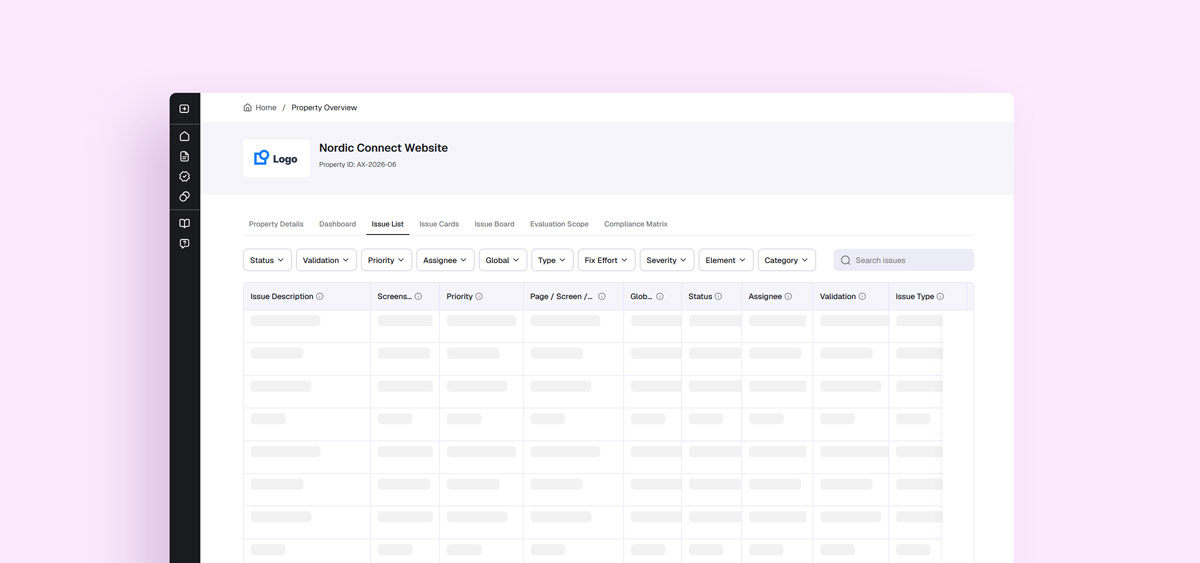
Accessibility Evaluation Report & Remediation Guidance
What's included:
- Every finding mapped to the specific EN 301 549 requirement or WCAG success criterion it fails
- Categorised for easy filtering: severity, priority, fix effort, and issue type — so the right team owns it (code, content, or design) — plus component
- Recommendations to fix, and a screenshot showing exactly where the issue is
- Written in evaluator-to-team language — developers, designers, and content creators can act on it directly.
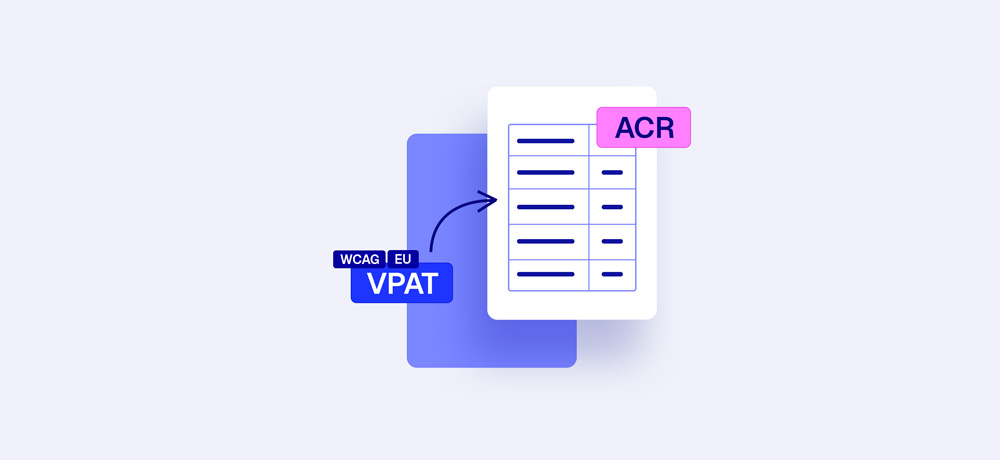
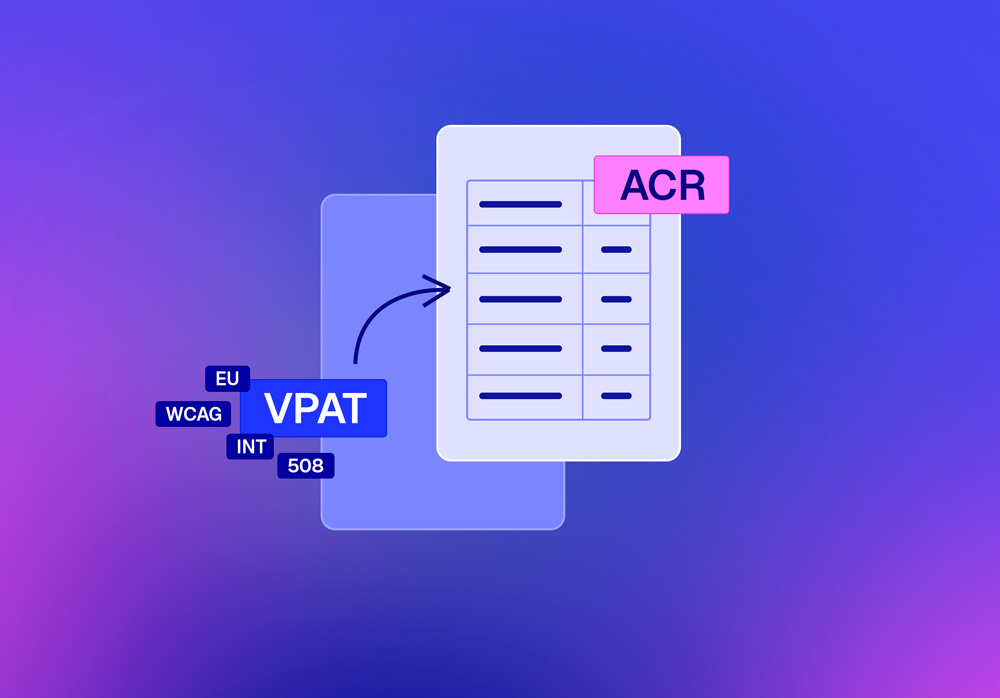
Accessibility Conformance Report (ACR)
What's included:
- Problems found and described directly in VPAT/ACR language — no separate report
- Criterion-by-criterion conformance rating: Supports, Partially Supports, Does Not Support, Not Applicable, Not Evaluated
- Delivered as a single, ready-to-share document.
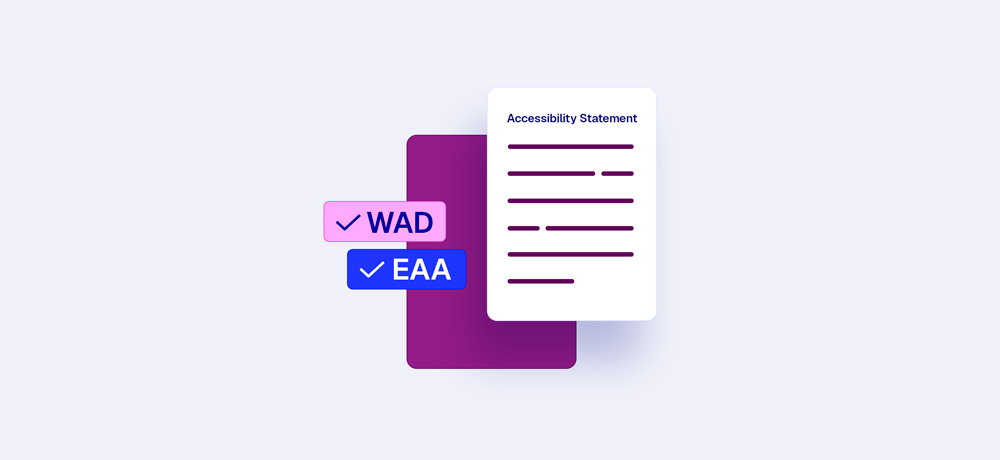
Accessibility Statement
What's included:
- Compliance status and non-accessible content described in plain language
- A feedback channel confirmed in your statement, using your existing contact method — mandatory or standard practice depending on your sector
- Built to the right legal basis for your sector: WAD's model format (public), or EAA's disclosure requirement (private).
ACR and statement are commonly ordered together — your ACR's findings become the compliance-status section of your statement.
Hands-On Remediation
What's included:
- HTML, CSS, and ARIA — direct code-level fixes for markup, styling, and accessible attributes
- WordPress and Webflow — platform-specific remediation within your existing build
- Documents (Word, Excel, PDF) — the same hands-on fix, along with the findings and fixes list
- JavaScript-dependent fixes — coordinated through a trusted development partner when needed.
Tell us what you're solving for, and we'll scope accordingly
Who this is for

ICT and compliance leads
responsible for accessibility across more than one product or property

Product and engineering leads
who need to know what applies before they ship, not after an audit finds it

Legal and procurement teams
who need inspection- and tender-ready documentation on demand
Frameworks we audit against
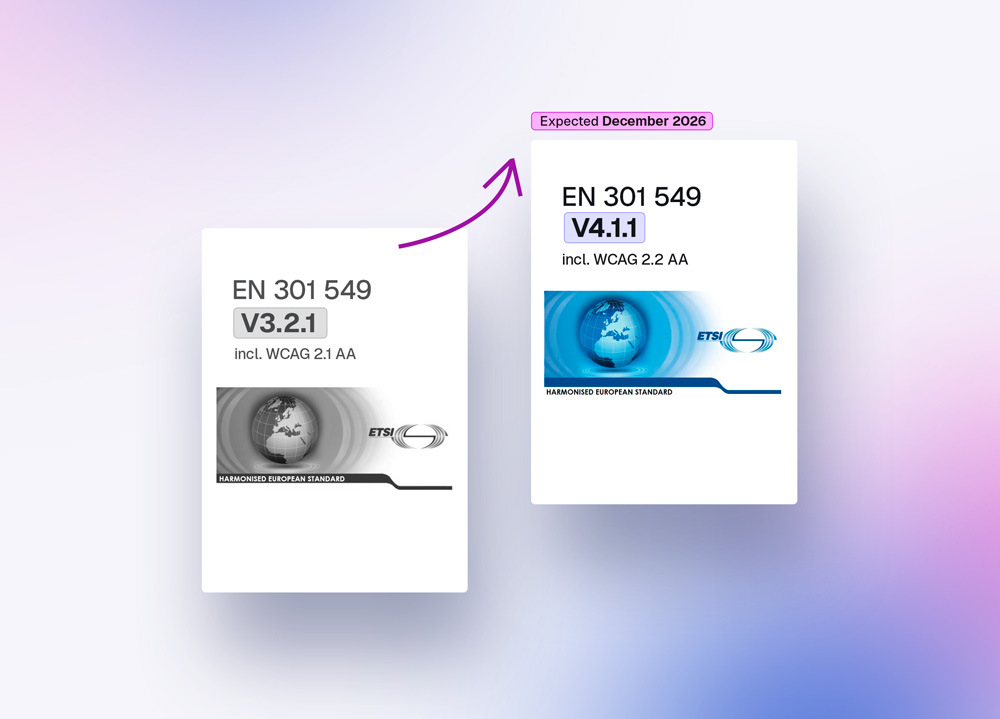
EN 301 549 is the technical standard you're evaluated against — WCAG is the web-content piece inside it. WAD and EAA decide who has to comply and with what, and each lands in Lithuania through its own transposition: WAD via government resolution, EAA via the law XIV-1633. Whichever applies to you, it's mapped into one audit.

The European standard for ICT accessibility. Voluntary to adopt, but citation in the Official Journal gives it legal presumption of conformity with EU accessibility directives.
The W3C web content guidelines. Incorporated into EN 301 549 as the basis for its web and software content requirements.
The Web Accessibility Directive. Governs public sector websites and apps, and mandates a specific model accessibility statement format.
The European Accessibility Act. Governs private-sector digital products and services across the EU — different disclosure requirements from WAD, no single mandated statement template.
Lithuania's national transposition of the EAA — Lietuvos Respublikos gaminių ir paslaugų prieinamumo reikalavimų įstatymas Nr. XIV-1633 — the governing legal text for Lithuanian-market compliance questions.
Lithuania's transposition of the WAD — Lietuvos Respublikos Vyriausybės 2003 m. balandžio 18 d. nutarimas Nr. 480 „Dėl bendrųjų reikalavimų valstybės ir savivaldybių institucijų ir įstaigų interneto svetainėms ir mobiliosioms programoms aprašo patvirtinimo“ — via government resolution (as amended) — governs public sector website and app accessibility requirements domestically.
Other services
Three accessibility services. One outcome: your organization is compliant, and stays compliant.
.png)
Accessibility Compliance Platform
Built for:
.png)
Accessibility Consultancy
Built for:
.png)
Book a consultation
Get in touch to schedule a call
Send us an email
letstalk@axall.digitalLet’s connect
LinkedinFAQ
If you provide e-commerce, banking, transport, e-books, or electronic communications services to EU consumers, yes, since June 2025 — with a narrow exemption for microenterprises on the services side. Scope depends on your specific service and where you operate; get in touch if you're unsure where you sit.
An audit is a one-time evaluation. The Platform is what keeps you compliant after: status tracking and assignment per issue, a compliance requirement matrix, and a hosted ACR that updates as fixes are verified — instead of managing it in spreadsheets across teams.
IAAP is the field's recognised credentialing body, and its certifications require passing a proctored exam. WAS certifies the technical skill to implement, test, and remediate accessibility issues in real code — it requires a minimum of three years of hands-on experience just to sit the exam. CPACC certifies the foundational knowledge that technical work has to be grounded in — disability types, laws, and standards. Together, they mean our findings come from verified, examined expertise. We're the only team in Lithuania holding both.
Depends on scope, complexity, and whether you need full ACR documentation, but a minimum of 4 weeks. We scope every engagement individually — get in touch with your platform details for a proposal.
Screen readers surface the same underlying structure — headings, roles, states, accessible names, landmarks — that other assistive technology depends on too. Voice control activates elements by their accessible name; switch access relies on focus order; braille displays read the same programmatic labels. When that structure is built correctly for a screen reader, it's built correctly for these other tools as well. That's why screen reader testing is our standard — not because other AT doesn't matter, but because it's the most sensitive method for catching the structural issues that affect all of them. Where a criterion depends on a different interaction pattern — like Label in Name for voice control — we verify that criterion directly, alongside the screen reader evaluation.
EN 301 549 is the standard cited in EU accessibility directives — that citation gives it legal presumption of conformity. WCAG is incorporated inside it as the web content basis. In practice, testing against EN 301 549 covers WCAG and adds the requirements WCAG doesn't — hardware, non-web software, documents, support services.
No. An ACR isn't a legal requirement under WAD or EAA. It's evidence — the format procurement and legal teams recognise when assessing a vendor's conformance claims.
If you operate in the Lithuanian market, XIV-1633 is the governing text, not the EAA directive directly. Scope and enforcement details are set nationally.
Official guidance recommends reviewing accessibility statements at least annually. A full re-audit makes sense on that same cadence, or sooner after a major redesign, platform change, or new feature launch.
Yes. Our quality seals confirm a platform was assessed by us and met the criteria evaluated — a verifiable record of the work and what it found. Worth noting: no official certifying body exists for WCAG or EN 301 549, so this isn't a third-party accreditation — it's ours, backed by the evaluation behind it.