EN 301 549, Not WCAG, Is Europe's Legal Accessibility Standard

Here's a common misconception worth correcting: the Web Content Accessibility Guidelines (WCAG) are not, on their own, the legal accessibility standard in Europe.
EN 301 549 — the Harmonised European Standard titled "Accessibility requirements for ICT (Information and Communications Technology) products and services" — is the one that actually carries legal weight, though not quite in the way most people assume.
Why EN 301 549 Is the Standard That Matters – Even Though It's "Voluntary"
Two EU directives govern digital accessibility:
- The Web Accessibility Directive (WAD) (Directive 2016/2102), covering public sector websites and apps
- The European Accessibility Act (EAA) (Directive 2019/882), covering private sector products and services
Some specialists will correctly point out that EN 301 549 isn't strictly mandatory. The standard describes itself, in its own text, as providing "one voluntary means of conforming to the essential requirements" of the directives — not the only means. In principle, an organisation could try a different technical approach and argue independently that it meets the WAD or the EAA.
But here's the part that decides which standard actually gets used in practice: only EN 301 549 comes with a shortcut through enforcement.
Once a version of EN 301 549 is cited in the Official Journal of the EU (OJEU), meeting it creates a legal presumption of conformity. A surveillance or monitoring authority presumes you meet the directive's requirements — the burden of proof effectively shifts, and disputes narrow down to whether you met the standard's clauses, not whether your whole approach counts.
Choose any other route, and that presumption doesn't exist. You have to demonstrate, case by case, to the authority's satisfaction, that your alternative approach meets the same essential requirements — with no institutional benefit of the doubt.
So the relationship isn't "EN 301 549 vs. WCAG," and it isn't "EN 301 549 is mandatory" either. It's: EN 301 549 is the only route with a legal presumption behind it — and WCAG is one part of what it covers.
The Evidence: EN 301 549 Requires More Than WCAG Covers
This isn't just a legal technicality — it shows up directly in the technical requirements.
The International Association of Accessibility Professionals (IAAP) Nordic Chapter compiled a full list of EN 301 549 requirements that go beyond WCAG 2.1. Of 64 such requirements in the standard:
- 42 apply to websites (most also apply to mobile apps)
- 22 apply to mobile apps only
That means 42 legally relevant requirements for websites have no WCAG equivalent at all. No WCAG success criterion. No WCAG "how to meet" guidance. If your compliance process only checks WCAG, these 42 requirements go untested — and unmet.
They cover real, user-facing areas:
- Real-time text and communication — RTT, concurrent voice and text, interoperability between communication services
- Video, captions, and audio description — playback, synchronization, and user controls, not just presence
- Biometrics — accessible use of fingerprint and facial-recognition verification, a category WCAG doesn't address
- User preferences — a dedicated requirement that accessibility settings must be respected
- Authoring tools and content creation — that the tools used to create content support accessible output
- Documentation and support — that accessibility and compatibility features are discoverable, for users and support staff alike
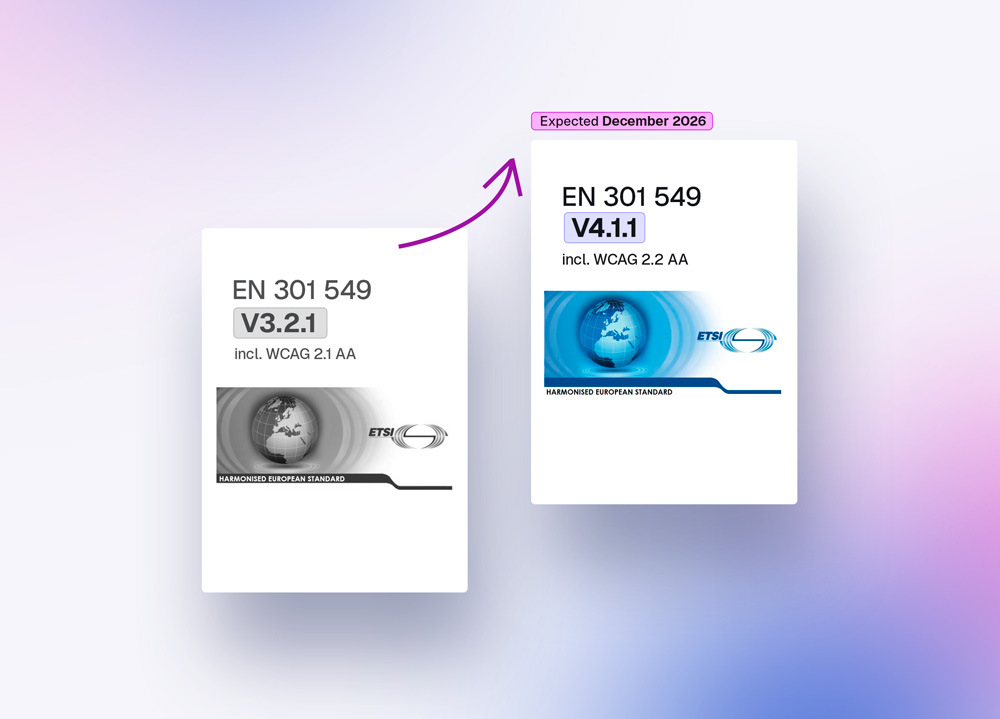
And that list is about to grow. A new EN 301 549 version is moving through standardisation now, adding further requirements on top of a shift from WCAG 2.1 to WCAG 2.2 — see what changes and when it applies.
Why This Distinction Matters in Practice
An audit, statement, or vendor requirement built only on WCAG can look thorough and still be legally incomplete. It covers the WCAG-derived third of EN 301 549 and leaves the rest untested.
Getting this right means testing against EN 301 549 as a whole — not treating WCAG as a stand-in for it.
The Bottom Line
WCAG is a strong content standard, and a real part of EN 301 549. But it carries no legal presumption of its own, and neither does any alternative approach outside EN 301 549. Nobody is required to use EN 301 549 — but choosing not to means trading a straightforward legal presumption for an open-ended argument you have to win yourself, every time, with no institutional benefit of the doubt.
Its 64 "beyond WCAG" requirements, 42 of them applying directly to websites, are the clearest technical proof of why: WCAG alone was never meant to carry EU accessibility compliance on its own.
This overview draws on the IAAP Nordic Chapter's published list of EN 301 549 requirements beyond WCAG 2.1. For binding legal requirements, always check the current text of the WAD, the EAA, and the version of EN 301 549 cited in the Official Journal of the EU.
AxAll helps organizations meet EU accessibility law – through EN 301 549 audits and remediation, a compliance platform, and expert consultancy.
Schedule a discovery call to start making your digital products compliant and accessible to people with disabilities.
Newsletter subscription
Twice a month we send insights, event updates, and valuable resources on best accessibility practices in Lithuania, the Baltics, and the EU market. Subscribe to get the latest knowledge and stay informed.