European Accessibility Act (EAA): scope, deadlines and what to do

The European Accessibility Act (EAA), Directive (EU) 2019/882, sets accessibility requirements for certain products and services provided to consumers. It has applied since 28 June 2025. In Lithuania it is transposed by Law Nr. XIV-1633.
This guide covers what the EAA applies to, who carries the obligations, who is exempt, what you must do and where Lithuanian law adds detail. To see how it fits with the Web Accessibility Directive (WAD), read WAD or EAA: which accessibility law applies to you.
Key dates
- 28 June 2022: deadline for Member States to adopt the national laws (Article 31(1)).
- 28 June 2025: the national laws apply (Article 31(2)). The Directive covers products placed on the market and services provided to consumers after this date (Article 2).
- 28 June 2030: end of the transitional period for service providers that keep using products they lawfully used before 28 June 2025, and the latest end date for service contracts agreed before 28 June 2025 (Article 32(1)).
What the EAA covers
Products placed on the market after 28 June 2025 (Article 2(1)):
- consumer general purpose computer hardware systems and their operating systems
- payment terminals
- self-service terminals dedicated to services covered by the Directive: automated teller machines (ATMs), ticketing machines, check-in machines and interactive information terminals
- consumer terminal equipment with interactive computing capability used for electronic communications services or for accessing audiovisual media services
- e-readers
Services provided to consumers after 28 June 2025 (Article 2(2)):
- electronic communications services
- services providing access to audiovisual media services
- elements of air, bus, rail and waterborne passenger transport: websites, mobile apps, e-tickets, travel information and interactive self-service terminals. For urban, suburban and regional transport, only the terminals are covered.
- consumer banking services
- e-books and dedicated software
- e-commerce services
The Directive also covers answering emergency communications to the number 112 (Article 2(3)).
Content not covered on websites and mobile apps (Article 2(4)): pre-recorded time-based media and office file formats published before 28 June 2025, certain online maps, third-party content the operator neither funds, develops nor controls, and archives not updated after 28 June 2025.
Who carries the obligations
The obligations fall on economic operators: manufacturers, authorised representatives, importers, distributors and service providers (Article 3(21)). A service provider is any natural or legal person who provides a service on the Union market or offers to provide one to consumers in the Union (Article 3(4)).
The recitals state that the obligations apply equally to economic operators from the public and private sectors (recital 57). A public sector body that sells a covered product or service to consumers is therefore not outside the EAA because of its status.
Who is exempt
Microenterprises providing services are exempt from the accessibility requirements and the related obligations (Article 4(5)).
A microenterprise employs fewer than 10 persons and has an annual turnover or an annual balance sheet total not exceeding EUR 2 million (Article 3(23)). Headcount and the financial figure are both part of the test. A turnover below EUR 2 million does not by itself make a company exempt, and the exemption does not cover products.
Microenterprises dealing with products are not exempt. They have lighter obligations, for example they do not have to document their disproportionate burden assessment (Article 14(4)). To benefit, a company must genuinely meet the definition (recital 53).
What you must do
Products (Article 7):
- design and manufacture to the accessibility requirements in Annex I
- draw up technical documentation and carry out the conformity assessment (Annex IV)
- issue an EU declaration of conformity and affix the CE marking
- keep the documentation and declaration for five years
- correct non-conformity and inform the authorities
Importers and distributors have their own duties (Articles 9 and 10).
Services (Article 13):
- design and provide services in line with the accessibility requirements
- publish information on how the service meets the requirements, in the general terms and conditions or an equivalent document (Annex V). It must be public, available in writing and orally, accessible to persons with disabilities, and kept for as long as the service operates.
- keep procedures in place so the service remains in conformity as it, the requirements and the standards change
- correct non-conformity and inform the authorities immediately
- supply information to the authority on a reasoned request
For websites and apps used in a service, the Directive requires them to be perceivable, operable, understandable and robust (Annex I, Section III). It does not name WCAG.
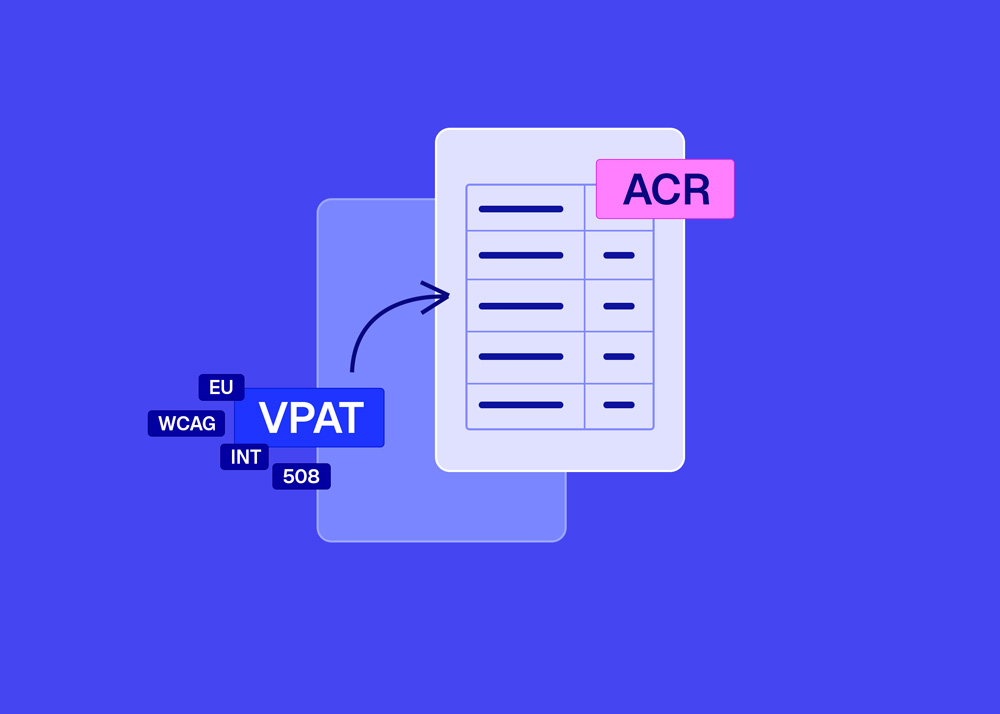
An Accessibility Conformance Report (ACR) is the evidence behind the Annex V information. It records conformance criterion by criterion, so the information rests on documented findings that procurement and legal teams can review.
Fundamental alteration and disproportionate burden
The requirements apply only to the extent that they do not require a fundamental alteration of a product or service, or impose a disproportionate burden (Article 14(1)). If you rely on this:
- assess it using the criteria in Annex VI and document the assessment (Article 14(2) and (3))
- keep the results for five years (Article 14(3))
- service providers renew the assessment when the service changes, when requested, and at least every five years (Article 14(5))
- inform the market surveillance authority (Article 14(8)). Microenterprises are not required to do this.
- you cannot rely on it if you received funding intended to improve accessibility (Article 14(6))
Standards and presumption of conformity
Products and services that conform to harmonised standards cited in the Official Journal of the European Union (OJEU) are presumed to conform to the corresponding requirements (Article 15(1)).
EN 301 549 V4.1.1 was published on 2 September 2026 (what changes and when it applies). Its OJEU citation is expected on 22 January 2027. That date is announced, not yet confirmed in the Official Journal. Until a reference is published, the presumption does not yet apply to V4.1.1.
Enforcement
Member States must provide effective means of enforcement, including action by consumers and by organisations with a legitimate interest, and penalties that are effective, proportionate and dissuasive (Articles 29 and 30).
In Lithuania
References in this section are to Law Nr. XIV-1633 (consolidated version of 30 June 2026), not to the Directive.
- Law: Law on Accessibility Requirements for Products and Services Nr. XIV-1633 (Lietuvos Respublikos gaminių ir paslaugų prieinamumo reikalavimų įstatymas), in force from 28 June 2025 (Article 30(1)).
- Market surveillance authorities (Article 6):
- State Consumer Rights Protection Authority (Valstybinė vartotojų teisių apsaugos tarnyba): products, and consumer banking, e-book and e-commerce services
- Lithuanian Transport Safety Administration (Lietuvos transporto saugos administracija): passenger transport services
- Communications Regulatory Authority (Ryšių reguliavimo tarnyba): electronic communications services
- Radio and Television Commission (Lietuvos radijo ir televizijos komisija): access to audiovisual media services
- Microenterprises: microenterprises providing services are exempt (Article 7(1)).
- Non-conformity: a service provider informs the market surveillance authority within 5 working days of learning of it (Article 13(5)).
- Evidence on request: at least 3 working days to supply the documents on a reasoned request (Article 13(6)). The same minimum applies to a copy of the disproportionate burden assessment (Article 14(3)).
- Fines (Article 23): EUR 500 to 2,500 for a non-conforming product or service. EUR 1,000 to 6,500 for continuing after the authority has banned or restricted it, or ordered the service to stop. EUR 2,500 to 15,000 where it harmed health.
- Limitation: fines can be imposed up to 5 years after the violation, or after it came to light if it continues (Article 25).
- Appeal: decisions can be appealed within one month of being served (Article 27).
What to do now
- Identify your role: manufacturer, authorised representative, importer, distributor or service provider.
- List the products and services you offer to consumers and check them against Article 2.
- Check whether you are a microenterprise providing services.
- Evaluate each product and service against the Annex I requirements. Axall benchmarks against EN 301 549.
- Publish the Annex V information in your terms and conditions or an equivalent document, in an accessible form.
- Put procedures in place to keep the service in conformity as it, the requirements and the standards change.
- If you rely on disproportionate burden, assess and document it and notify the authority.
- Keep your evidence, including an ACR, for as long as the service operates.
- Not sure where you stand? See where you stand with our short compliance check.
Sourcing note: this guide is based on Directive (EU) 2019/882 (EAA), including Article 3, Annexes I, V and VI and recitals 53 and 57, and on Lithuanian Law Nr. XIV-1633 (consolidated version of 30 June 2026). The OJEU citation date for EN 301 549 V4.1.1 is expected, not confirmed. For anything binding, read the primary legal texts or ask a legal adviser. This guide is not legal advice.
Accessibility compliance self-assessment
How compliant are you with EU accessibility law?
Assess your organisation in 3 minutes — then talk it through in a free 30-min consultation.
Subscribe to the AxAll newsletter
Once or twice a month: articles, event updates and practical resources on digital accessibility in Lithuania, the Baltics and the EU. Subscribe to the AxAll newsletter to stay informed.